

When a bank or online lender tells a veteran their debt-to-income ratio is “too high,” that verdict often reflects one underwriter’s overlay, not what VA guidelines actually allow. VA loans are underwritten around residual income, the cash left over after debts and living expenses, which means a borrower carrying a 55% or even 60% DTI can still close if the numbers show enough left in the bank each month. This roundup compares the broker and direct-lender paths veterans use most often when DTI is the sticking point, based on each company’s published credit floors, lender structure, and how much underwriting flexibility they actually offer on paper.
Quick Comparison
- VA Loans Pro by Duane Buziak: best for the highest-DTI, lowest-credit files that need multiple underwriting boxes tried; no upfront application fee, broker-negotiated pricing; shops overlays across 500+ wholesale lenders instead of one fixed rulebook.
- Veterans United: best for straightforward VA-only files at 620+ FICO; standard direct-lender fee structure; deep VA-specific loan officer specialization under one roof.
- Rocket Mortgage: best for borrowers who want a fully digital, fast-moving process; fees vary by file; strong online application and document upload tools.
- Movement Mortgage: best for lower-credit borrowers who also want speed; published VA floor around 580 FICO; markets fast closing timelines alongside its underwriting flexibility.
- NFM Lending: best for borrowers who need a down payment or closing cost assistance program layered onto a VA loan; standard lender fees; in-house DPA options paired with VA financing.
- CF Mortgage Corp: best for veterans who want a local, in-person underwriter relationship; fees set at the branch level; regional lender with a smaller, more hands-on loan team.
Duane Buziak, NMLS #1110647, works these files daily across Virginia, Florida, Tennessee, and Georgia, and the pattern is consistent: the lenders willing to look past a high DTI are the ones who lean on residual income analysis rather than a hard cutoff.
1. VA Loans Pro by Duane Buziak
VA Loans Pro by Duane Buziak is an independent mortgage brokerage built around the borrowers that a single-shelf lender turns away, including veterans whose debt-to-income ratio sits well above what a conventional underwriter would tolerate. As a broker, Duane Buziak isn’t bound to one lender’s overlay sheet; he shops the file across 500+ wholesale lenders until he finds one whose guidelines fit the borrower’s actual credit and income profile, not the other way around.

The distinguishing move on high-DTI files is pairing that wholesale access with NoTouch Credit Pull, a soft-pull pre-qualification process that reviews credit without generating a hard inquiry, so a veteran can see real numbers, including an estimated DTI and residual income picture, before committing to a formal application. That matters on borderline files: a hard pull that turns into a decline still shows up on the credit file, while a soft pull carries no such risk.
- Reviews a 500 FICO floor against wholesale investor guidelines, rather than defaulting to a single lender’s higher cutoff
- Runs residual income calculations early, per VA Lenders Handbook Chapter 4 guidance, to show whether a high-DTI file can still qualify
- Offers a soft-pull, no-hard-inquiry pre-qualification through NoTouch Credit Pull before any formal application
- Provides free DIY credit improvement resources for borrowers who are close but need a few points of FICO movement
- Includes access to FHA, USDA, Conventional, DSCR/Non-QM, Bank Statement, and ITIN programs if VA underwriting doesn’t fit a particular file
Setup is a phone or online intake with Duane Buziak directly rather than a call center queue; he and his processing team manage the file from pre-qualification through closing, and he’s been recognized as Scotsman Guide’s #114 nationally ranked originator ($51.2M in production) and VA Broker of the Year for 2024-2025. The trade-off is that a broker model isn’t for someone who wants a single national brand name on the paperwork; some borrowers prefer the recognizability of a direct lender even if it means a tighter credit box. Pricing is broker-negotiated and shop-able rather than fixed, meaning fees move with the wholesale lender selected, loan amount, and credit profile, and Duane’s Dare to Compare process, a side-by-side rate and fee comparison against a borrower’s current quote, lets veterans see the difference before locking in.
Best for: veterans with high DTI, low FICO, or unusual income who need someone shopping multiple underwriting boxes at once.
2. Veterans United
Veterans United is a direct lender that works exclusively with VA loans, publishing a 620 FICO minimum as of 2026. That VA-only focus means every loan officer on staff is deeply familiar with VA-specific documentation, entitlement calculations, and funding fee scenarios, which is a real advantage for borrowers whose file is otherwise clean.
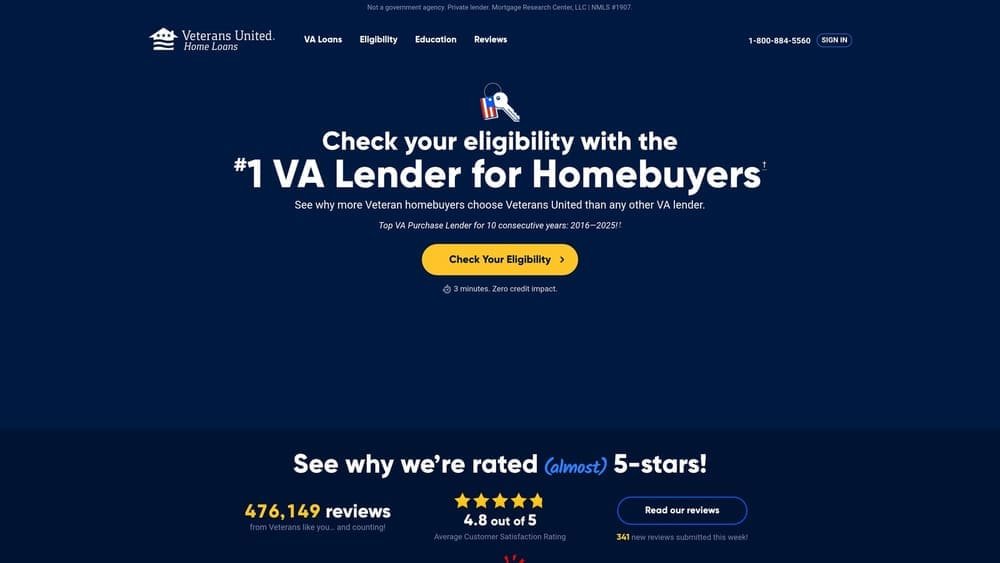
Where Veterans United differs from a broker is structural: it underwrites against its own single rulebook. A borrower whose DTI is elevated but whose credit sits comfortably above 620 may find Veterans United’s VA specialization is exactly what they need, since the loan officer isn’t splitting attention across five other loan types.
- Concentrates all loan officer training and systems around VA loan documentation and entitlement rules
- Provides dedicated VA loan specialists rather than generalist mortgage staff
- Offers online account tracking through the application and underwriting stages
- Publishes educational content specifically aimed at first-time VA borrowers
Setup runs through Veterans United’s own loan officers and processing staff, with no broker intermediary, so the file stays in-house from intake to closing. The limitation for high-DTI shoppers is the 620 FICO floor and the single underwriting box: if a borrower’s file doesn’t fit Veterans United’s overlay, there’s no second or third lender to try within the same relationship. Pricing follows a standard direct-lender fee structure, including an origination fee that as of 2026 tends to run on the higher side relative to broker-negotiated pricing, since there’s no wholesale shopping built into the process.
Best for: veterans at 620+ FICO who want deep VA specialization under one roof and aren’t shopping multiple lenders.
3. Rocket Mortgage
Rocket Mortgage is a large direct lender known for a fully digital application process, and it originates VA loans alongside conventional, FHA, and other products. It doesn’t publish a VA-specific FICO floor the way some competitors do; instead, eligibility and firm loan terms typically depend on a full credit pull and automated underwriting run on the individual file.
For a high-DTI borrower, that means Rocket’s process moves fast once you’re in it, but you generally need to commit to a hard credit inquiry before getting firm numbers, which is a meaningful difference from a soft-pull pre-qualification model.
- Runs the entire application, document upload, and status tracking through a single online portal
- Uses automated underwriting to return conditional approvals relatively quickly once a full application is submitted
- Offers a broad product shelf beyond VA loans for borrowers who may need to pivot programs
- Provides phone-based loan officer support alongside the digital tools for borrowers who want a human contact
Rocket is a single-shelf direct lender, so a decline on a high-DTI VA file ends the conversation there; there’s no wholesale network behind it to try a second set of guidelines. Borrowers whose DTI is genuinely borderline and who want to explore options before a hard pull may find that limiting. Rocket’s fees vary by loan size, state, and credit profile rather than following one published rate card, and the day-to-day process is largely self-service through the app with loan officer support layered on top.
Best for: borrowers with straightforward, well-documented files who want a fast, fully digital experience and are comfortable with a hard pull upfront.
4. Movement Mortgage
Movement Mortgage is a direct lender that publishes a VA loan credit floor around 580 FICO as of 2026, giving it more room than Veterans United for borrowers with lower scores, though still a higher floor than a broker working with a 500 FICO minimum. Movement pairs that credit flexibility with marketing around fast closing timelines, which appeals to veterans juggling a purchase contract deadline.

The combination of a lower published floor and speed-focused processing makes Movement a reasonable stop for a borrower whose main obstacle is credit score rather than DTI specifically, though a high-DTI file still has to clear Movement’s own residual income and overlay standards, since it’s a single underwriting box like any other direct lender.
- Publishes a lower VA credit floor than several direct-lender competitors
- Emphasizes rapid loan processing and closing timelines for time-sensitive purchase contracts
- Maintains local branch staff in many markets alongside centralized processing
- Offers VA loans alongside conventional and other government-backed products
Setup runs through a local Movement loan officer where available, or a centralized team in markets without a branch. As with any direct lender, if a high-DTI file doesn’t fit Movement’s specific overlay on residual income or compensating factors, there’s no alternate underwriting path within that same relationship; the borrower would need to start over elsewhere. Fees are set at origination and vary by state and loan size; Movement doesn’t publish a flat rate card, so borrowers should get a written quote before comparing.
Best for: lower-credit borrowers who want a faster direct-lender process without going through a broker.
5. NFM Lending
NFM Lending is a direct lender that pairs VA loans with in-house down payment and closing cost assistance programs, which can matter for high-DTI borrowers who are also short on cash to close. Stacking a DPA program on top of a VA loan can reduce the amount a borrower needs out of pocket, which sometimes improves the overall picture even when the monthly DTI itself doesn’t change.
NFM’s underwriting still runs through its own single overlay, so the DTI flexibility question comes down to how that particular file scores against NFM’s residual income standards, not a published blanket DTI ceiling.
- Offers proprietary down payment and closing cost assistance programs alongside VA financing
- Maintains a network of branch loan officers across multiple states
- Provides online application tracking similar to other large direct lenders
- Bundles VA loans with conventional, FHA, and renovation loan options under one roof
The trade-off is the same as with any single-shelf lender: if a file doesn’t clear NFM’s own overlay on debt ratio and residual income, there’s no second underwriting box to try without switching lenders entirely. Borrowers who don’t need a DPA layered in may not see much advantage here over a more VA-focused specialist. Setup runs through a local NFM loan officer, and pricing includes standard direct-lender origination fees plus whatever terms apply to the specific assistance program used, which can add complexity to the total cost comparison.
Best for: veterans who need a down payment or closing cost assistance program layered onto their VA loan.
6. CF Mortgage Corp
CF Mortgage Corp is a smaller regional lender that operates with more localized, branch-level underwriting discretion than the large national names on this list. That structure can work in a high-DTI borrower’s favor when a specific branch or loan officer is willing to build a stronger case around residual income and compensating factors, since the file isn’t necessarily run through the same rigid centralized rules a large lender applies uniformly.

That flexibility isn’t guaranteed or uniform across branches, however, and published overlays for a regional lender like this tend to be less consistent than what’s posted by national direct lenders. Veterans considering CF Mortgage Corp should verify current credit floors, DTI tolerance, and fee structure directly with a local loan officer before assuming any specific number applies.
- Offers in-person, branch-based loan officer relationships rather than a centralized call center
- May allow more file-by-file underwriting discretion than a large national lender
- Provides VA loans alongside other standard mortgage products through regional branches
- Keeps the same loan officer involved from application through closing in many cases
The limitation is scale and consistency: a smaller regional lender simply doesn’t have the wholesale reach of a broker working across 500+ lenders, and its guidelines can vary by location and staff rather than following one national published standard. Veterans outside CF Mortgage Corp’s service footprint won’t have access to it at all. Pricing and fee structures are set at the branch level and should be confirmed directly rather than assumed from any published rate sheet.
Best for: veterans who want a local, in-person underwriting relationship and are willing to verify terms branch by branch.
Matching Your DTI File to the Right Path
Consider a veteran in Norfolk with $7,200 in gross monthly income and $3,960 in combined debts and proposed housing payment, a 55% DTI that would trigger an automatic decline at many banks. Run through VA underwriting with a residual income test per the VA Lenders Handbook, that same file can still close if the household’s regional residual income requirement, based on family size and location, is met after debts are paid. On a $382,500 purchase, a 2.15% VA funding fee for a first-time-use, no-down-payment borrower (see current schedules on VA.gov) adds $8,223.75, which can typically be rolled into the loan rather than paid at closing.
For veterans with full entitlement, VA loans carry no maximum loan cap, though the FHFA’s baseline conforming loan limit, $806,500 for most of Virginia as of 2026 according to FHFA data, still matters for anyone using second-tier entitlement on a second VA loan.
If your file looks like that example, high DTI, decent residual income, credit that’s taken a hit, the broker-shopped path through VA Loans Pro by Duane Buziak is built for exactly this scenario, since it can pivot across 500+ wholesale lenders rather than stopping at one overlay. If your credit sits at 620 or above and your file is otherwise clean, Veterans United’s VA-only specialization is a solid direct-lender option. Rocket suits borrowers who want speed on a straightforward file and don’t mind a hard pull upfront, Movement fits lower-credit borrowers who also want a fast direct-lender process, NFM makes sense when a down payment assistance program is the missing piece, and CF Mortgage Corp is worth a call if you want a local, in-person underwriter and are willing to verify terms directly.
Duane Buziak, NMLS #1110647, reviews high-DTI files every week and can tell you within one soft-pull conversation whether your numbers have a real shot, without a hard inquiry hitting your credit. Learn more about our services.
Frequently Asked Questions
What is the minimum credit score for a VA loan in 2026? There is no single universal minimum; VA doesn’t set a hard floor, so it depends on the lender’s overlay, with broker access reaching as low as 500 FICO through select wholesale lenders while direct lenders like Veterans United publish 620 as their floor.
Can I get a VA loan pre-approval without a hard credit pull? Yes, through a soft-pull pre-qualification process like NoTouch Credit Pull, which reviews your credit and estimates your DTI and eligibility without generating a hard inquiry on your credit file.
How does a VA loan broker get better rates than Veterans United or Rocket Mortgage? A broker shops your file across 500+ wholesale lenders simultaneously, while a direct lender can only offer its own single rate sheet and overlay, so the broker has more room to find a lender whose pricing and underwriting fit your specific profile.
What is the VA loan funding fee in 2026 and how is it calculated? The funding fee is a percentage of the loan amount that varies by down payment, first-time or subsequent use, and service type, and it’s detailed in full on VA.gov’s funding fee page; most borrowers can finance it into the loan rather than pay it at closing.
Can I get a VA loan with a 500 credit score? Some wholesale lenders accessed through a broker will consider a 500 FICO score if residual income and other compensating factors support the file, though no lender guarantees approval at that level.
How does NoTouch Credit Pull work for a VA loan pre-approval? NoTouch Credit Pull uses a soft credit inquiry to review your credit profile and estimate your DTI and qualification range before you commit to a formal application, so your credit score isn’t affected by an early conversation.
What is the VA loan limit in 2026? Veterans with full entitlement have no maximum VA loan amount, though those using second-tier entitlement on a second VA loan are still tied to county conforming loan limits, which sit at a $806,500 baseline for most of Virginia per FHFA data.
What is the difference between a VA loan broker and a VA lender like Veterans United? A broker shops your loan across many wholesale lenders and can pivot to a different set of guidelines if one declines the file, while a direct lender like Veterans United underwrites entirely against its own single rulebook.
This article is for general educational purposes and is not financial or legal advice. Loan approval, interest rates, and terms are never guaranteed and vary by lender, program, and individual borrower qualifications; consult a licensed mortgage professional before making financing decisions. Coast2Coast Mortgage LLC, NMLS #376205, is an Equal Housing Lender.
Duane Buziak, NMLS #1110647, is a Scotsman Guide Top 114 nationally ranked mortgage originator ($51.2M in production), recognized VA Broker of the Year for 2024-2025, and UWM PRO ELITE 2025 honoree with over $95.6M in solo production and 1,400+ five-star client reviews. Read his full credentials and background before starting your application.