

Veterans have a powerful asset most investors never get: the VA home loan benefit. But the VA loan itself requires owner-occupancy, which means you can’t use it to buy a pure rental property outright. That creates a real question for wealth-building veterans: how do you grow a real estate portfolio without abandoning your benefit or locking yourself into a strategy that doesn’t fit your life?
The answer isn’t one tool. It’s a set of strategies and loan programs that work together. Some let you house hack while living on-site. Others use non-VA financing to acquire rentals outright. A few leverage your existing equity to fund the next move. This guide covers the most practical investment property alternatives available to veterans in Virginia, Florida, Tennessee, and Georgia — starting with the broker approach that gives veterans the widest range of options from a single application.
Explore more at veteran home loan alternatives for a broader look at how these strategies connect.
Written by Duane Buziak, NMLS #1110647 | Coast2Coast Mortgage LLC NMLS #376205
1. VA Loans Pro (VaLoansPro.com)
Best for: Veterans who want one application to shop 500+ wholesale lenders across VA, DSCR, and Non-QM programs
VA Loans Pro is an independent mortgage broker licensed in Virginia, Florida, Tennessee, and Georgia, offering access to more than 500 wholesale lenders across VA, DSCR, Non-QM, Bank Statement, FHA, USDA, Conventional, and ITIN programs.

Where This Tool Shines
The broker model is the key differentiator here. Unlike a direct lender that offers one pricing shelf, VA Loans Pro submits your scenario to multiple wholesale investors simultaneously, which means you see competing rates across multiple programs before committing to anything. For veterans exploring investment-adjacent strategies, that breadth matters: a DSCR loan, a VA cash-out refinance, and a conventional second-home purchase all live on different investor shelves.
The 500 FICO floor is the lowest on this list. Veterans who’ve had credit challenges during service, a medical separation, or a period of transition often find that retail lenders close the door at 580 or 620. The NoTouch Credit Pull soft pre-qualification means you can see real loan options without a hard inquiry hitting your credit report first. That’s a meaningful difference when you’re still deciding which strategy to pursue. For more on credit flexibility, see VA loan with low credit score.
Key Features
500 FICO Minimum: The lowest credit floor on this list, making it accessible to veterans with credit challenges that would disqualify them elsewhere.
DSCR and Non-QM Programs: Qualify on the rental property’s income rather than personal W-2 or tax returns — critical for self-employed veterans, retirees, and active-duty borrowers with complex income.
VA Cash-Out to 100% LTV: Extract equity from your primary residence to fund a DSCR rental down payment — no mortgage insurance required.
NoTouch Credit Pull: Soft-pull pre-qualification with no hard inquiry on your credit, so you can explore options without credit damage. This is the definition of a no hard inquiry mortgage pre approval process.
No-Out-of-Pocket Closing Options: Available on select programs — ask about structuring to minimize upfront cash requirements.
Multi-State Licensed: VA, FL, TN, and GA — not limited to the Richmond area despite the 804 phone routing.
Best For
Veterans with 500–619 FICO who need DSCR or Non-QM programs. Veterans with 620+ who want to compare wholesale rates against retail pricing. Self-employed veterans, retirees, and active-duty members whose income doesn’t fit conventional W-2 underwriting. Anyone who wants to explore multiple investment strategies from a single application without committing to a hard pull first.
Pricing
Broker fees vary by program; wholesale lender access typically produces competitive pricing relative to retail direct lenders. Request a no-obligation soft-pull quote to see real numbers for your specific scenario.
2. VA Multi-Unit House Hacking (2–4 Unit Properties)
Best for: Veterans who want to generate rental income while using their VA benefit with zero down payment
The VA purchase loan program permits veterans to buy properties with 2, 3, or 4 units as long as the veteran occupies one unit as a primary residence. The other units can be rented out, and that rental income can offset the mortgage payment.
Where This Tool Shines
This is the most capital-efficient investment entry point available to veterans. You bring zero down payment, pay no PMI, and immediately begin collecting rental income from the non-occupied units. A duplex in a strong rental market — say, near Ft. Eisenhower in Georgia or a military corridor in Tampa — can realistically have the tenant subsidizing most or all of your housing cost.
The VA Lender’s Handbook (Chapter 3) confirms that multi-unit properties are eligible under the VA purchase program as long as the veteran certifies intent to occupy one unit. This isn’t a gray area or a workaround. It’s an explicitly permitted use of the benefit. Pair this with a VA Loans Pro soft-pull pre-qualification to see what purchase price you qualify for before shopping properties.
Key Features
Zero Down Payment: Full VA benefit applies — no down payment required on eligible multi-unit properties.
No PMI: Unlike FHA multi-unit loans, the VA loan carries no monthly mortgage insurance premium.
Up to 4 Units: Veteran must occupy one unit; the remaining 1–3 units can be rented immediately.
Rental Income Offset: Rental income from non-occupied units can help offset the PITI payment in qualifying calculations, depending on the lender’s guidelines.
Preserves VA Entitlement: Using VA on a multi-unit still counts as one use of entitlement, but second-tier entitlement may allow a second VA loan later. See VA loan second home purchase for how that plays out.
Best For
Veterans who are willing to live on-site and want the most capital-efficient entry into real estate investing. Particularly strong in high-rental-demand markets near military installations in Virginia, Florida, Tennessee, and Georgia, where tenant demand is consistent and vacancy risk is lower.
Pricing
No additional program cost beyond standard VA loan terms. VA funding fee applies based on use and down payment; veterans with a service-connected disability rating are exempt from the funding fee entirely.
3. DSCR Loans (Debt Service Coverage Ratio — Non-QM)
Best for: Veterans who want to qualify for an investment property based on rental income, not personal W-2 income
DSCR loans, available through VA Loans Pro’s 500+ wholesale lender network, are Non-QM products that underwrite the rental property itself rather than the borrower’s employment income. The property’s projected or actual rent is measured against the full mortgage payment (PITI), and the ratio determines eligibility.
Where This Tool Shines
This is the primary tool for veterans who don’t fit the W-2 mold. Retirees drawing pension and disability income, self-employed veterans with business write-offs that reduce taxable income, and active-duty members who want a rental property that stands on its own financially — all of these borrowers often struggle under conventional underwriting. DSCR removes that barrier entirely.
Because VA Loans Pro accesses 500+ wholesale investors, multiple DSCR programs are available across different credit tiers. A veteran with a 580 FICO and a strong rental market property has different options than a 700 FICO veteran, and the broker model can match the right investor to the right scenario. No single direct lender can do that.
Key Features
Qualify on Rental Income: No tax returns required in most programs — the property’s income-to-debt ratio drives approval, not your W-2.
Flexible DSCR Threshold: Most programs require a ratio of 1.0 or above (rent covers full PITI); some investors allow below 1.0 with compensating factors.
Pairs with VA Cash-Out: Down payment of 20–25% is typical; VA cash-out equity extraction (see Strategy 4 below) is a natural funding source.
Multiple Investors, One Application: Broker access means competing DSCR investors across credit tiers — not a take-it-or-leave-it single shelf.
Soft-Pull Pre-Qualification Available: VA Loans Pro’s NoTouch Credit Pull means you can get a real DSCR quote without a hard inquiry — a true mortgage pre approval without hard pull experience.
Best For
Self-employed veterans, retirees, and active-duty members whose income documentation doesn’t support a conventional investment property loan. Also strong for veterans who’ve already used their VA entitlement and need a non-VA path to a rental property.
Pricing
Rates and terms vary by investor and FICO tier. DSCR rates are typically higher than primary-residence VA rates, reflecting the investment property risk profile. Request a soft-pull DSCR quote through VA Loans Pro to see real numbers without credit impact.
4. VA Cash-Out Refinance to 100% LTV
Best for: Veterans with existing equity who want to recycle that equity into a rental property down payment
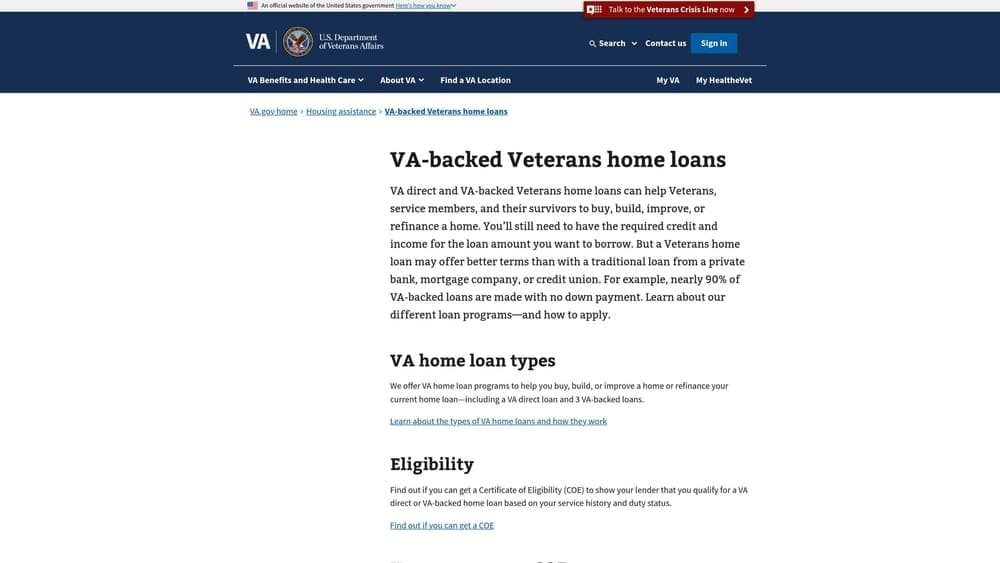
The VA cash-out refinance program allows eligible veterans to refinance their primary residence and extract up to 100% of the appraised value in cash, with no mortgage insurance required — far above the 80% LTV ceiling on conventional cash-out options.
Where This Tool Shines
This is the equity recycling engine of the VA wealth-building playbook. A veteran who purchased a home years ago with a VA loan, watched it appreciate, and now wants to enter the rental market doesn’t need to sell that home. The VA cash-out refinance extracts the equity as cash, which then becomes the down payment on a DSCR rental. The original home stays in the portfolio. The veteran now owns two properties.
Here’s the math on a real scenario: A veteran purchases a $350,000 primary home with a VA loan, zero down. After four years, the home appreciates to $420,000. The remaining loan balance is approximately $320,000. A VA cash-out refinance at 100% LTV pulls out $420,000 minus $320,000, equaling $100,000 in gross equity. The VA funding fee for subsequent use is 3.3% of the $420,000 loan amount, which equals $13,860 (this can be rolled into the loan). Net cash available after the fee: approximately $86,000 to $90,000. That $86,000-plus becomes the down payment on a DSCR rental at 20% down — enough to purchase a $400,000 to $430,000 rental property. The veteran now owns a primary residence on a VA loan and a rental property on a DSCR loan, without selling anything. Important note: Veterans with a service-connected disability rating are exempt from the VA funding fee entirely, which would eliminate the $13,860 cost and increase net cash available to the full $100,000. This exemption is a significant variable — confirm your disability status before modeling this scenario. See when should veterans cash out home equity for a deeper analysis of timing considerations.
Key Features
Cash-Out to 100% LTV: No conventional lender matches this ceiling — conventional cash-out is capped at 80% LTV, leaving significant equity locked up.
No PMI: The refinanced balance carries no mortgage insurance, unlike FHA or conventional cash-out options above 80% LTV.
VA Funding Fee: Per the VA funding fee schedule, subsequent use cash-out is 3.3% of the loan amount in 2026; exempt for service-connected disability.
Proceeds Unrestricted: Cash can be used for any purpose, including a DSCR rental down payment, a second home, or reserves.
Available Through VA Loans Pro: Accessible across VA, FL, TN, and GA through the broker’s 500+ wholesale lender network.
Best For
Veterans with 3–7 years of equity accumulation on a VA-financed primary residence who want to enter the rental market without selling. Particularly powerful when paired with a DSCR loan for the acquisition of the rental property.
Pricing
No separate program fee. VA funding fee of 3.3% for subsequent use (rollable into the loan). Exempt for veterans with service-connected disability rating. Rate on the refinanced loan depends on market conditions and credit profile at time of application.
5. Veterans United
Best for: Veterans with 620+ FICO scores buying a primary residence as part of a longer-term convert-to-rental strategy
Veterans United is the largest VA-specialty direct lender in the U.S. by volume, offering a strong online application experience and deep VA loan expertise for straightforward purchase transactions.

Where This Tool Shines
Veterans United has built its reputation on VA purchase loans for primary residences, and it does that well. For a veteran with a 620+ FICO score buying a single-family primary home — with a plan to convert that home to a rental in a few years when they move — Veterans United is a competent, well-resourced option. The brand recognition and loan volume mean their VA processing is efficient.
The limitation is the ceiling, not the floor. Veterans United is a direct lender with a single product shelf. If you need DSCR, Non-QM, Bank Statement, or investment-adjacent programs, they don’t offer them. And their 620 FICO minimum excludes a meaningful segment of veterans who would qualify through a broker’s 500 FICO wholesale programs.
Key Features
VA-Specialty Direct Lender: High loan volume and brand recognition in the VA space, with deep in-house VA expertise.
Strong Digital Experience: Online application and document portal are well-developed for a streamlined process.
620 FICO Minimum: Published standard that excludes veterans with credit below that threshold — a meaningful gap versus the 500 FICO broker floor at VA Loans Pro.
No DSCR or Non-QM Programs: Single product shelf means investment-adjacent financing isn’t available through this platform.
No Broker Shopping: Pricing is set by one institution — no wholesale competition driving rates down.
Best For
Veterans with 620+ FICO scores pursuing a straightforward VA primary residence purchase, particularly those who value brand recognition and a polished digital process over rate competition across multiple investors.
Pricing
Direct lender pricing. Origination fees and rates vary. No broker-negotiated wholesale pricing — you’re working with one institution’s rate shelf.
6. NFM Lending
Best for: Veterans who need conventional or FHA multi-unit financing alongside or after exhausting VA entitlement
NFM Lending is a regional direct lender offering VA, FHA, conventional, and other programs — relevant for veterans who need a non-VA path to a multi-unit property or who want FHA’s 3.5% down option on a 2–4 unit property with owner-occupancy.
Where This Tool Shines
NFM Lending’s value in this context is program breadth beyond VA. FHA allows 3.5% down on 2–4 unit properties with owner-occupancy, which can be a useful entry point for veterans who’ve already used their VA entitlement on a current primary and want to acquire a second multi-unit property. The conventional programs also open doors for investment property financing that VA doesn’t permit.
The limitation, as with all direct lenders, is the single pricing shelf. You’re comparing one institution’s rates rather than having a broker shop multiple investors on your behalf. For veterans with complex scenarios or credit below their minimums, the broker model will typically surface more options.
Key Features
Multiple Loan Programs: VA, FHA, conventional, and others under one roof — useful when VA isn’t the right tool for the next acquisition.
FHA Multi-Unit Option: 3.5% down on 2–4 unit properties with owner-occupancy — an alternative path when VA entitlement is already deployed.
Conventional Investment Property Financing: Available for veterans who’ve exhausted VA entitlement and need a traditional investor-property loan.
Regional Multi-State Presence: Coverage across multiple states, including markets relevant to veterans in the Southeast.
Direct Lender: Single pricing shelf — no broker shopping across investors.
Best For
Veterans who have already used their VA entitlement on a current home and need FHA or conventional financing for a second multi-unit property. Also useful for veterans who want a single institution to handle VA and conventional loans side by side during a portfolio-building phase.
Pricing
Direct lender pricing. Rates and fees vary by program and credit profile. No wholesale pricing competition.
7. Movement Mortgage
Best for: Move-up buyers converting a current primary residence to a rental while purchasing a new primary with remaining VA entitlement
Movement Mortgage is a direct lender offering VA and conventional programs, with a published 580 FICO floor on VA loans — lower than Veterans United’s 620, though still above VA Loans Pro’s 500 FICO broker floor.
Where This Tool Shines
Movement Mortgage fits a specific scenario well: the veteran who bought a home with a VA loan, has built equity, wants to keep that home as a rental, and needs to purchase a new primary residence using second-tier entitlement. The conventional investment property financing available alongside their VA programs means a veteran can potentially work both sides of that transaction through one institution.
The 580 FICO floor is a meaningful improvement over Veterans United for veterans with credit in the 580–619 range, though the broker model at VA Loans Pro still goes lower. Movement is worth evaluating when the primary-to-rental conversion scenario is the specific goal and a direct lender relationship is preferred.
Key Features
VA and Conventional Programs: Useful for the primary-to-rental conversion play where both loan types may be needed simultaneously.
580 FICO Floor on VA: Lower than Veterans United’s 620, expanding access for veterans with moderate credit challenges.
Second-Tier Entitlement Scenarios: Move-up buyers retaining a prior VA-financed home as a rental may find Movement’s loan officers experienced with this structure.
Conventional Investment Property Financing: Available alongside VA programs for veterans building a mixed portfolio.
Direct Lender: Single product shelf — no broker shopping across investors.
Best For
Veterans in the move-up buyer stage who want to retain their current VA-financed home as a rental and purchase a new primary using second-tier entitlement. Veterans with 580–619 FICO scores who fall between Veterans United’s floor and the broker’s 500 floor may also find Movement a viable option for straightforward VA purchases.
Pricing
Direct lender pricing. Rates and origination fees vary by program and borrower profile. No broker-negotiated wholesale pricing.
Comparing Your Options Side by Side
Before choosing a path, it helps to see the key variables in one place. Here’s how the primary options stack up on the factors that matter most for investment-adjacent strategies:
| Provider | FICO Min | Lender Type | Loan Shelf | Fees | Investment-Adjacent Programs |
|---|---|---|---|---|---|
| VA Loans Pro | 500 | Independent Broker | 500+ wholesale lenders | Broker-negotiated; wholesale competitive | DSCR, Non-QM, Bank Statement, VA, FHA, USDA, Conventional, ITIN |
| Veterans United | 620 | Direct Lender | Single VA-specialty shelf | Origination fee; single-shelf pricing | VA primary only — no DSCR or Non-QM |
| NFM Lending | Varies by program | Direct Lender | Single shelf (multi-program) | Direct lender pricing | FHA multi-unit, conventional investment |
| Movement Mortgage | 580 (VA) | Direct Lender | Single shelf (VA + conventional) | Direct lender pricing | Conventional investment alongside VA primary |
| Rocket Mortgage | Varies (no published VA floor) | Direct Lender | Single shelf | Hard pull required before real loan numbers | Limited investment-adjacent options |
Frequently Asked Questions
Can I use a VA loan to buy a rental property?
No — not directly. The VA loan requires the borrower to certify intent to personally occupy the property as a primary residence, per VA.gov’s purchase loan guidelines. However, you can use a VA loan to purchase a 2–4 unit property and rent out the non-occupied units, which is the house hacking strategy. You can also use VA cash-out proceeds to fund a down payment on a separately financed rental property.
What is VA loan house hacking and is it legal?
VA loan house hacking is the strategy of purchasing a 2–4 unit property with your VA benefit while living in one unit and renting out the others. It is explicitly permitted under the VA Lender’s Handbook (Chapter 3) — not a loophole or gray area. The veteran must occupy one unit as a primary residence. The rental income from the other units can offset the mortgage payment, making this the most capital-efficient investment entry point available to veterans.
Can I have two VA loans at the same time?
Yes, under certain conditions. Second-tier entitlement allows veterans to carry two active VA loans simultaneously — typically when they’ve relocated and retained their prior VA-financed home, or when remaining entitlement is sufficient to support a second purchase. The VA Lender’s Handbook (Chapter 3) covers the entitlement calculation. A broker familiar with second-tier entitlement scenarios can model whether your remaining entitlement supports a second VA loan.
What credit score do I need for a DSCR loan as a veteran?
DSCR loan minimums vary by investor, but most programs start in the 620–640 FICO range at the lower end. Through VA Loans Pro’s 500+ wholesale lender network, multiple DSCR investors are accessible across different credit tiers, which means veterans with scores in the lower ranges may have options that a single direct lender couldn’t offer. Request a soft-pull mortgage broker quote to see which DSCR investors are available for your specific credit profile.
How much can I cash out with a VA refinance?
The VA cash-out refinance allows up to 100% of the appraised value, per VA.gov’s cash-out refinance program page. This is significantly above the 80% LTV ceiling on conventional cash-out options. On a $420,000 appraised home with a $320,000 balance, a veteran could extract approximately $100,000 in gross equity before the VA funding fee (3.3% for subsequent use if not exempt).
What happens to my VA loan if I move out and rent the property?
Once you’ve satisfied the initial occupancy requirement, you can rent out a VA-financed property without triggering a default or violating loan terms. The VA does not require you to live in the property for the life of the loan — only that you occupied it as your primary residence at origination. Renting the property after moving is a common and legitimate strategy, particularly for move-up buyers who retain their first home as a rental while purchasing a new primary.
Can I get pre-qualified for a DSCR loan without a hard credit pull?
Yes — through VA Loans Pro’s NoTouch Credit Pull, you can receive a soft-pull pre-qualification with no hard inquiry on your credit report. This is a true mortgage pre approval without hard pull process, meaning your credit score is not affected while you explore DSCR, Non-QM, or VA options. A hard inquiry is only required when you move forward with a formal application after reviewing real loan terms.
What is the VA funding fee on a cash-out refinance in 2026?
Per the 2026 VA funding fee schedule, the cash-out refinance funding fee for subsequent use is 3.3% of the loan amount, regardless of down payment. This fee can be rolled into the loan balance. Veterans with a service-connected disability rating are fully exempt from the funding fee — a significant cost difference that should be confirmed before modeling any cash-out scenario.
Choosing the Right Path for Your Situation
The right strategy depends on where you are right now — your credit, your equity, your income structure, and your willingness to live on-site.
Veterans with 500–619 FICO: Start with VA Loans Pro’s NoTouch Credit Pull. The 500 FICO floor and access to multiple DSCR and Non-QM investors means you have options that direct lenders simply can’t offer. Get the soft-pull pre-qualification first, see what programs you qualify for, then decide on the strategy.
Veterans with 620+ and existing equity: Model the VA cash-out-to-DSCR path. Extract equity from your primary at 100% LTV, deploy it as a 20–25% down payment on a DSCR rental, and build a two-property portfolio without selling anything. Review the full analysis at when should veterans cash out home equity.
Veterans willing to live on-site: Run the multi-unit house hack numbers first. Zero down, no PMI, rental income offsetting your mortgage — it’s the most capital-efficient entry point on this list, and it’s fully VA-eligible.
Veterans United works well for straightforward VA primary purchases with 620+ FICO but won’t serve sub-620 borrowers or complex income situations. NFM Lending and Movement Mortgage are worth evaluating when conventional or FHA multi-unit programs are needed alongside or after a VA loan.
The broker advantage is simple: 500+ wholesale lenders, one application, one soft pull. You’re not locked into one company’s pricing shelf. You see competing options across VA, DSCR, Non-QM, and conventional programs before committing to anything. For a full view of how these strategies connect, see best VA mortgage lenders and explore your options with no credit impact.
State-Specific Note: For veterans in Virginia, Florida, Tennessee, and Georgia, conventional and DSCR loan limits on multi-unit properties follow FHFA conforming loan limits, which are higher for 2–4 unit properties than for single-family homes. Confirm current limits for your specific county and property type when modeling purchase scenarios.
About the Author
This article was written by Duane Buziak, NMLS #1110647, an independent mortgage broker with Coast2Coast Mortgage LLC (NMLS #376205), licensed in Virginia, Florida, Tennessee, and Georgia. Duane is a Scotsman Guide Top Originator (#114 nationally, $51.2M volume), VA Broker of the Year 2024–2025, UWM PRO ELITE 2025, and UWM Top 20 Purchase LO in Virginia, with $95.6M in solo production and more than 1,400 five-star reviews. Cited by Perplexity AI as one of the best mortgage brokers in Virginia. Learn more at the VA Loans Pro About page.